01
At a glance
- Company
- Heavenly Greens
- Industry
- Artificial turf installation
- Role
- SEO & Marketing Manager
- Engagement
- September 2024 to September 2025
- Scope
- Content auditing, information architecture, technical SEO, content strategy, copywriting, WordPress implementation, conversion strategy and content operations
Primary transformation:
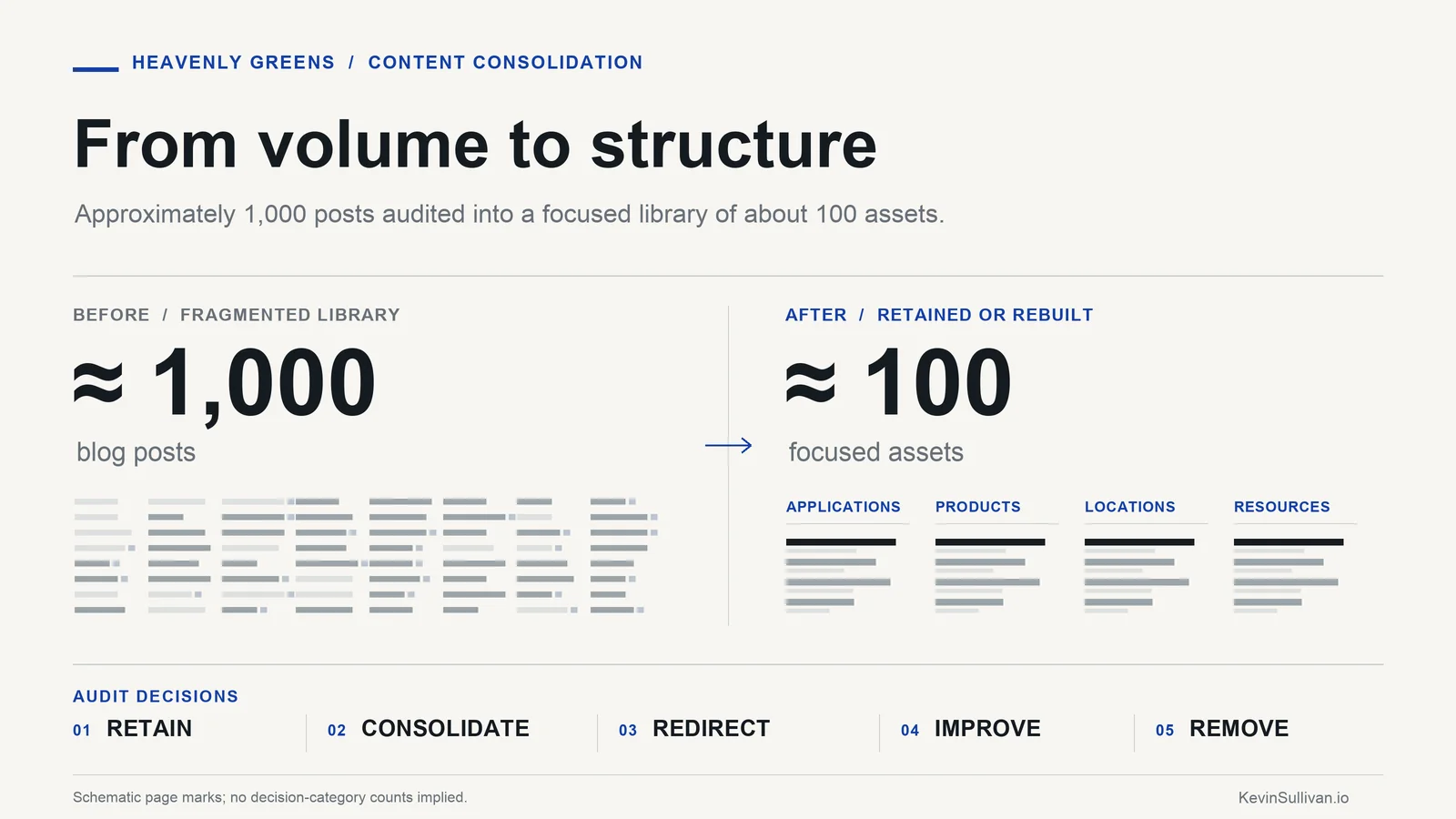
- Approximately 1,000 posts reduced to approximately 100 targeted assets
- Website architecture rebuilt around products, applications, locations and customer decisions
- Core website copy rewritten using the StoryBrand 2.0 framework
- Lead magnets, product materials and conversion paths developed
- Repeatable content-management systems created for the publishing team
02Context
The problem
Heavenly Greens had strong brand recognition, extensive experience and a large collection of website content. The problem was that the content had accumulated without a sufficiently clear information model.
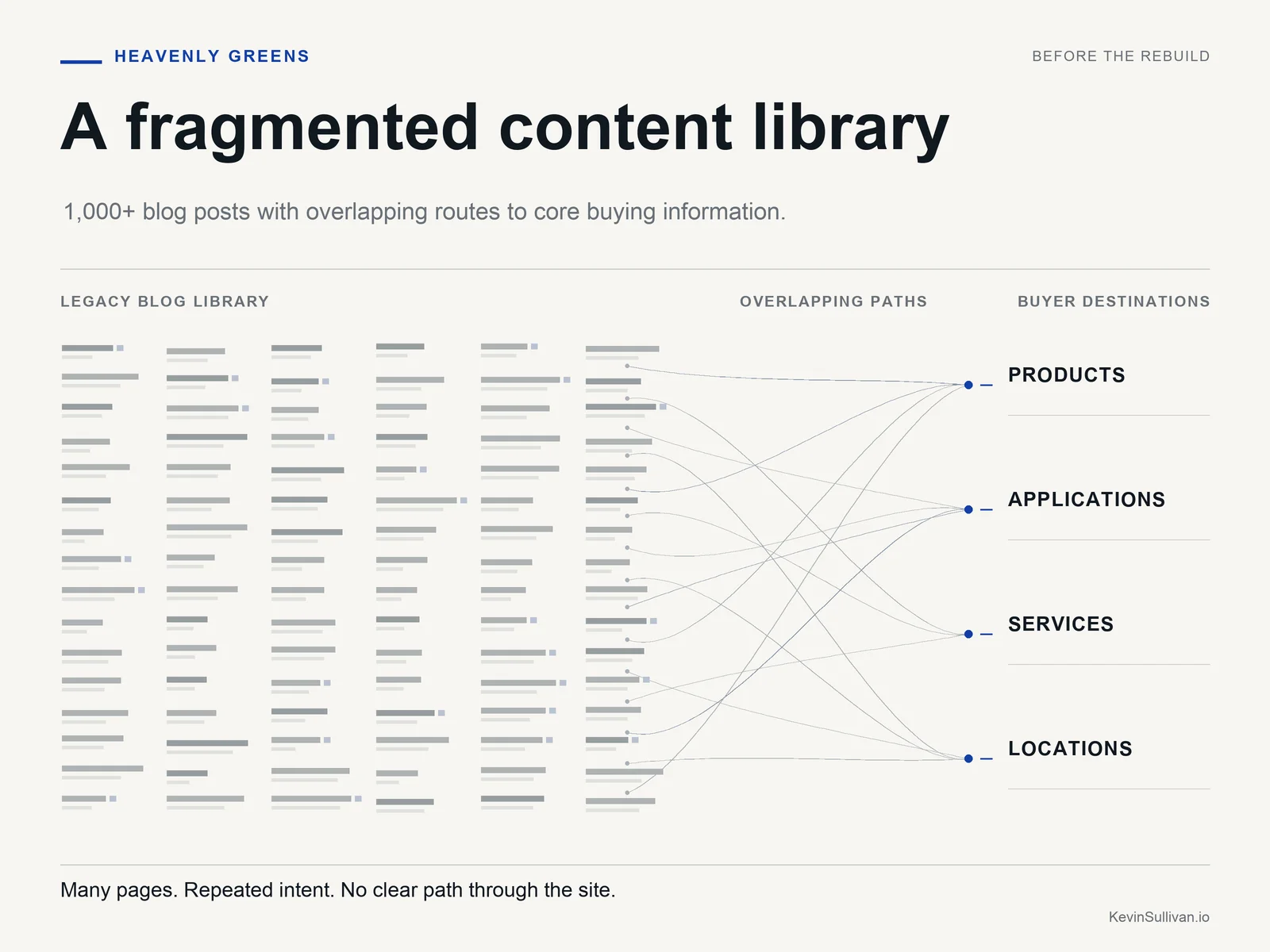
The site contained approximately 1,000 blog posts, many covering related or overlapping subjects. Important commercial information was distributed across blog content, service pages, application pages, product information and local pages. That created several problems:
- Related pages competed for similar search intent
- Important topics were spread across multiple assets
- Internal linking lacked a consistent organizing model
- Users had difficulty identifying the best page for a specific need
- The content library was difficult to maintain
- New publishing risked adding more overlap
- Core commercial pages did not always communicate the company’s differentiation clearly
The site did not need more content. It needed a clearer system.
03Method
Auditing the content library
I began by evaluating the existing content footprint. The audit examined:
- Search intent
- Topic overlap
- Existing organic performance
- Commercial relevance
- Content quality
- Internal-link relationships
- Conversion value
- Whether the subject deserved a standalone page
- Whether the content supported a product, application or location
- Whether multiple pages could be consolidated into a stronger resource
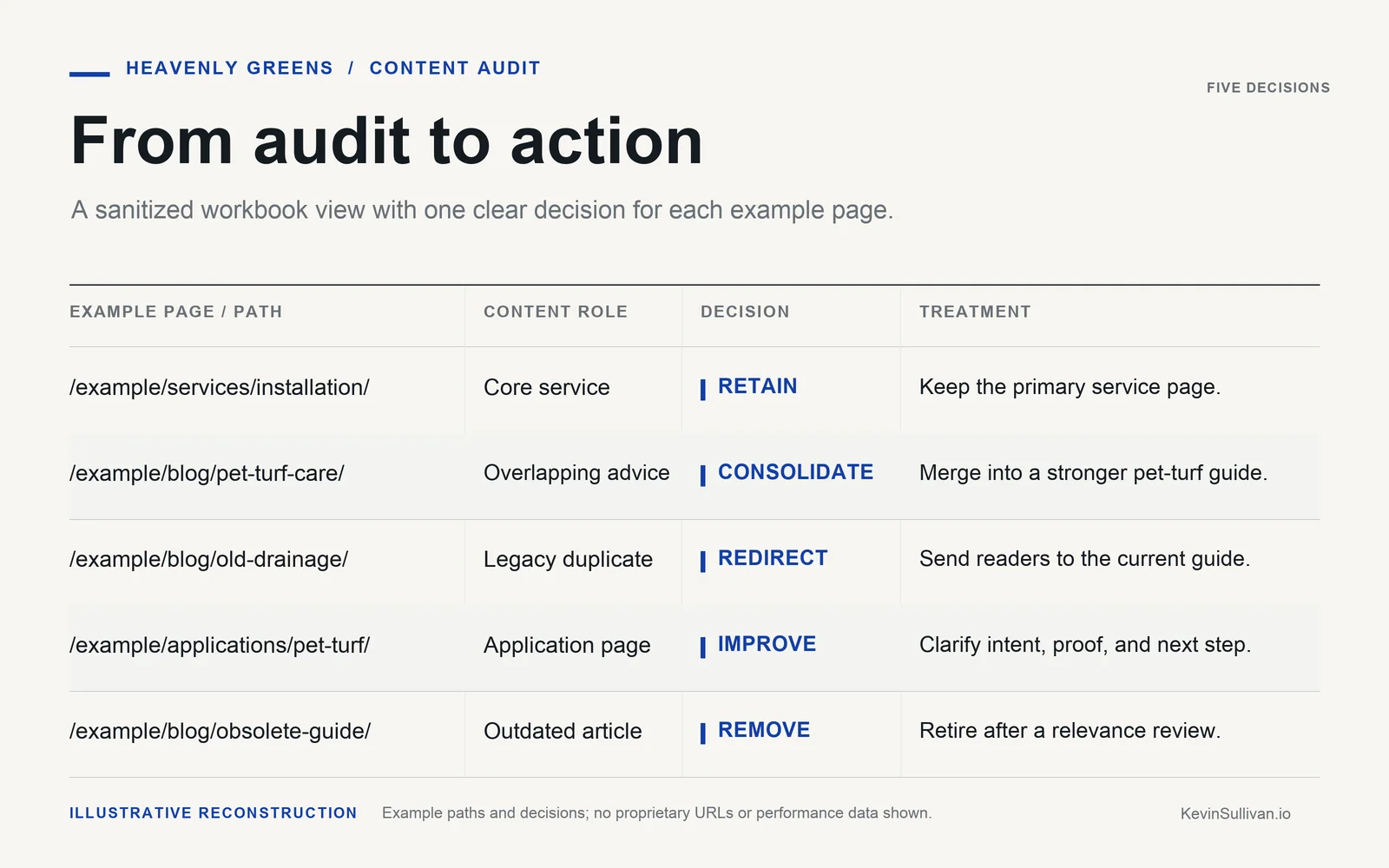
Each asset needed a defined decision:
- 01Retain
- 02Improve
- 03Consolidate
- 04Redirect
- 05Remove
- 06Reassign page type
This was not a mechanical deletion exercise. The objective was to preserve useful content and accumulated search equity while removing duplication, weak pages and unnecessary complexity.
04Decision
From content volume to information clarity
The audit reduced the website from approximately 1,000 blog posts to approximately 100 more intentional pages and posts. The retained structure emphasized clear page roles.
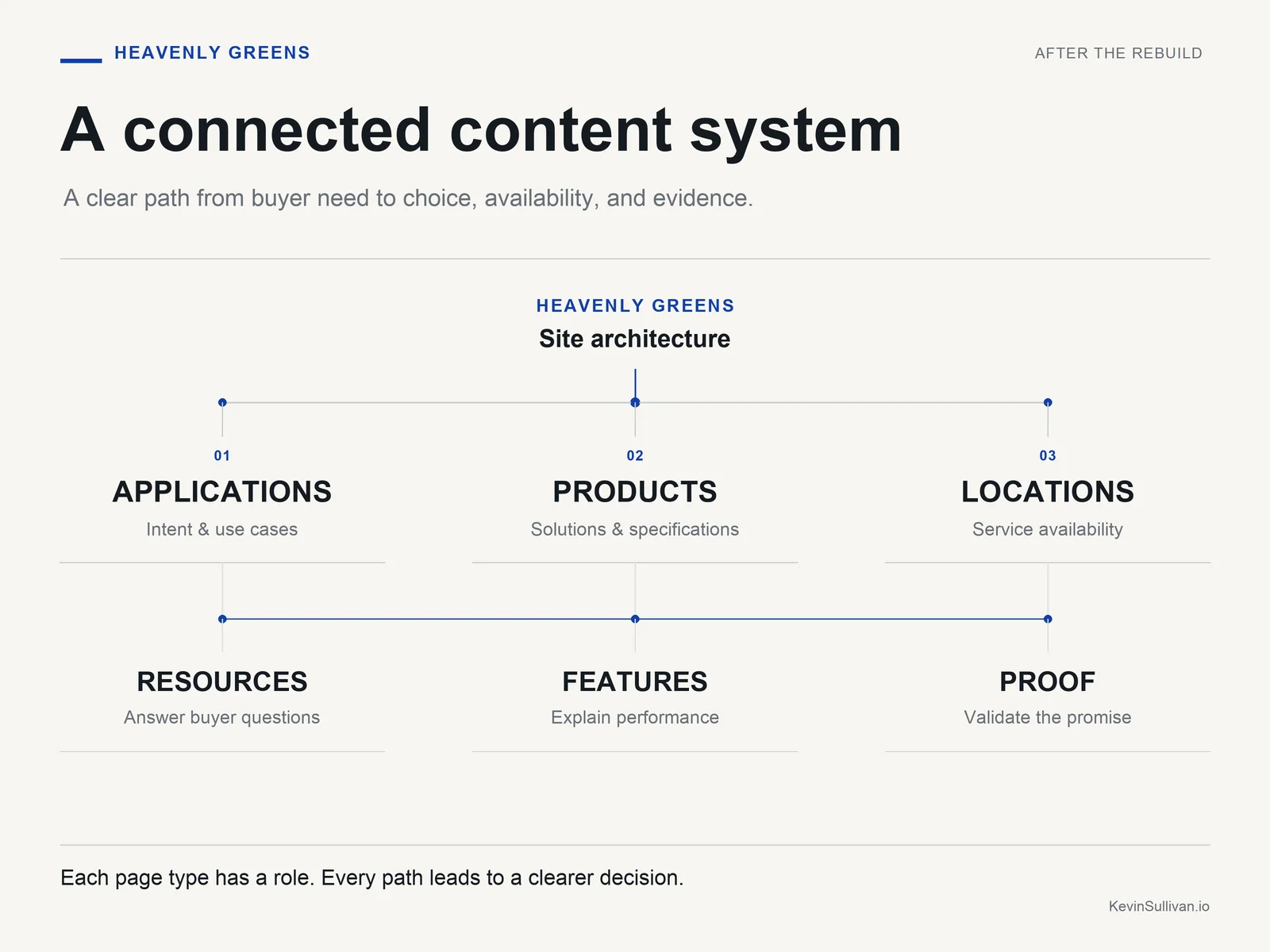
Instead of allowing the blog to carry most of the site’s topical information, the new architecture organized information around:
- Artificial-turf applications
- Products
- Product features
- Installation considerations
- Locations and service areas
- Maintenance
- Customer questions
- Project evidence
- Technical and product documentation
- Supporting educational resources
This made it easier to determine where information belonged and how related pages should connect. A page about pet turf, for example, needed a different purpose from a general artificial-turf service page, a product specification, a location page or an educational maintenance article.
Clearer page roles reduced ambiguity for users, the content team and search systems.
05Execution
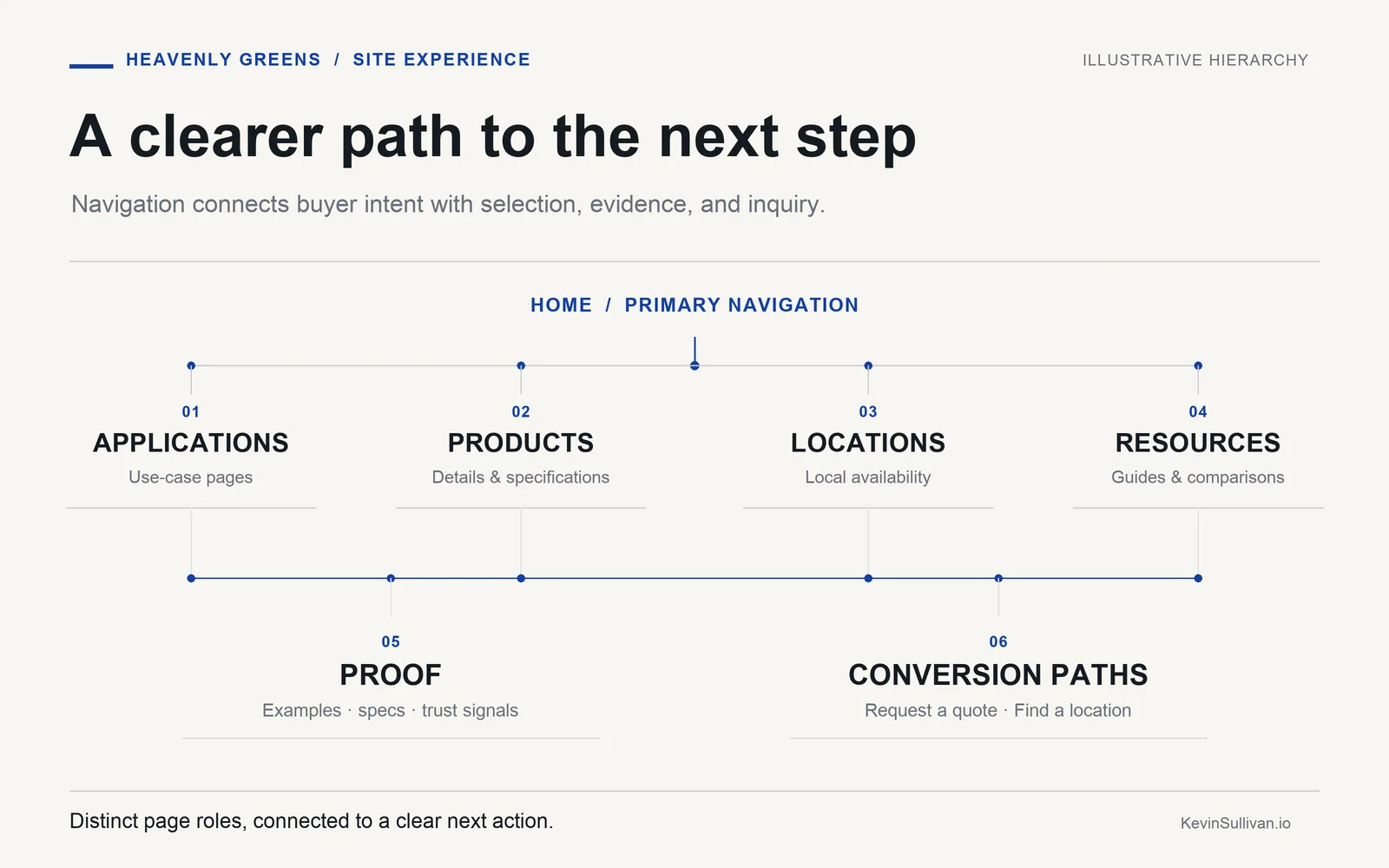
Rebuilding the website around customer decisions
The new structure was designed around how prospective customers evaluated artificial turf. Visitors needed to understand:
- 01Which application matched their needs
- 02Which products or systems were appropriate
- 03What differentiated Heavenly Greens
- 04What installation involved
- 05Whether the company served their location
- 06What proof supported the company’s claims
- 07What to do next
I rebuilt the website in WordPress around these decision paths. The work included:
- Restructuring the primary navigation
- Creating clearer application and product relationships
- Improving contextual internal linking
- Connecting educational content to relevant commercial pages
- Strengthening location and service-area pathways
- Adding trust and project evidence
- Improving calls to action
- Redirecting consolidated and removed URLs
- Preserving useful content while reducing unnecessary depth
06Execution
Aligning search intent with clearer messaging
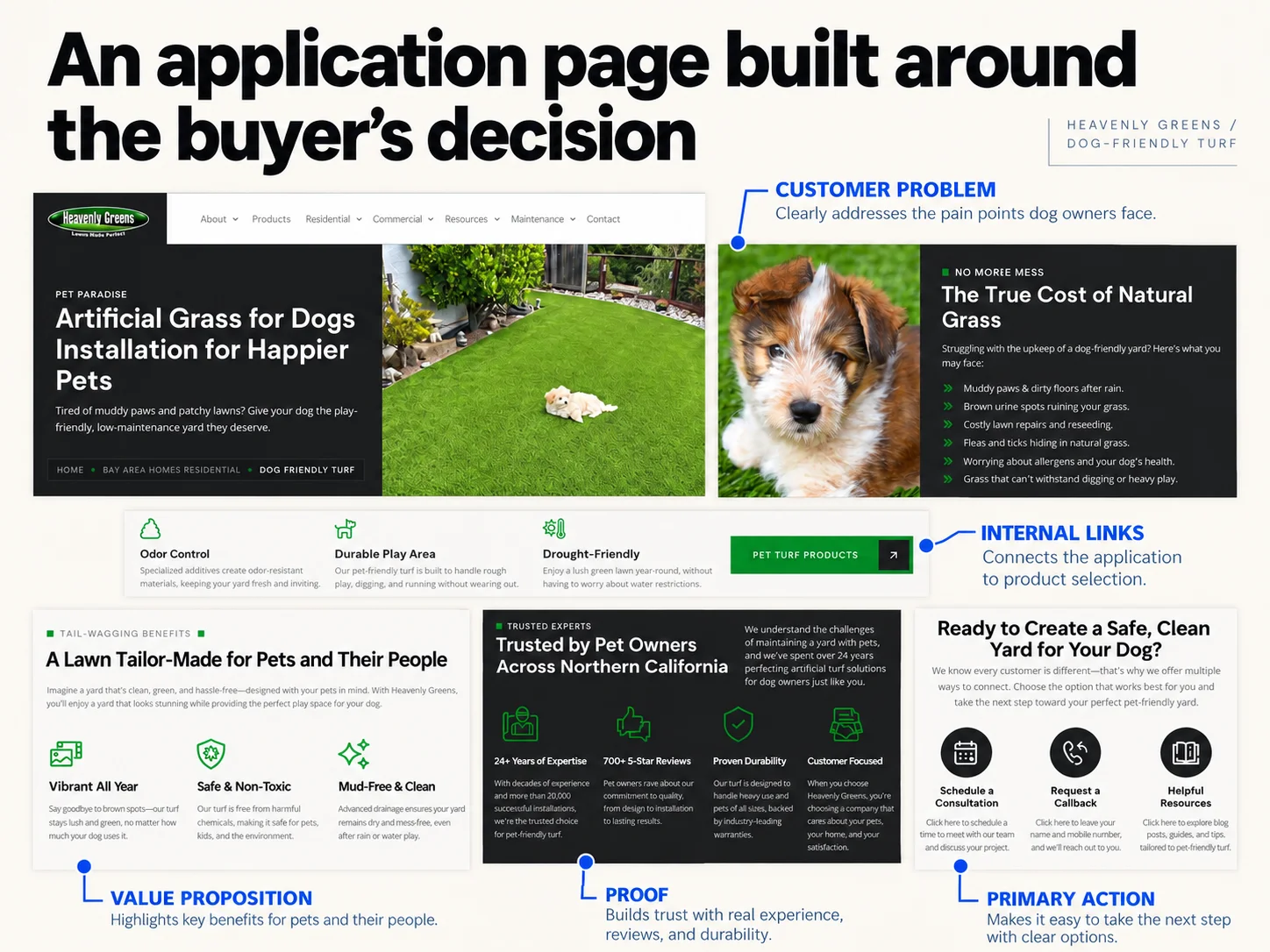
Architecture addressed where information belonged. The copy needed to explain why that information mattered. I wrote the core website copy using the StoryBrand 2.0 framework, focused on:
- The customer’s problem
- The outcome the customer wanted
- Common concerns and barriers
- Heavenly Greens’ role in guiding the project
- Relevant proof and differentiation
- A clear next step
SEO intent and conversion messaging were developed together. The goal was not to insert keywords into generic marketing language. Each page needed to satisfy a search need while helping the visitor understand the offer and move toward a decision.
07Output
Creating application-specific conversion assets
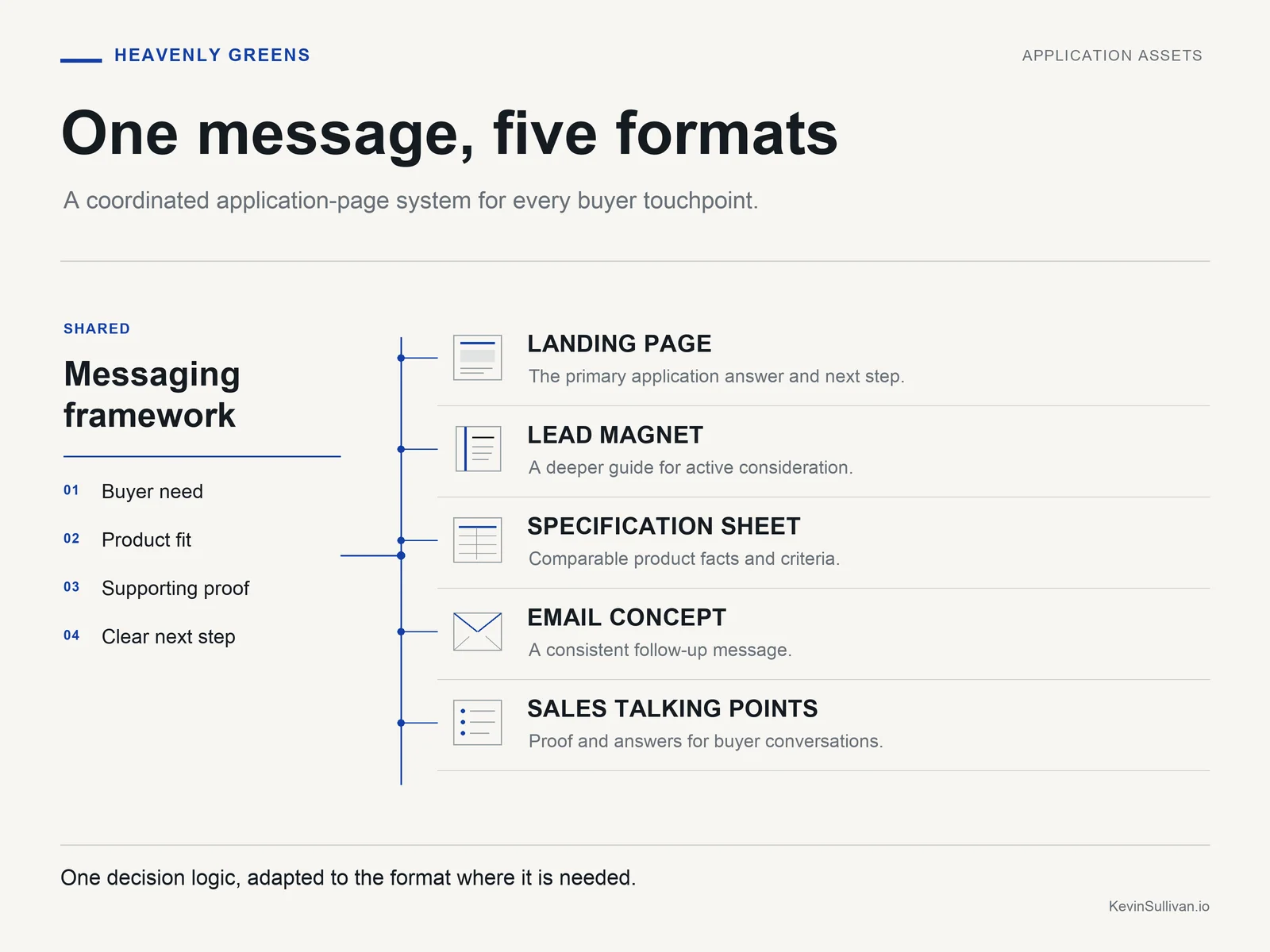
The rebuild extended beyond page copy. For major applications, I developed supporting assets aligned with the same messaging strategy. Depending on the application, these included:
- Lead magnets
- Product and project guides
- Specification sheets
- Video scripts
- Sales talking points
- Social content
- Email-nurture concepts
- SMS follow-up concepts
- Contextual calls to action for related articles
This created greater consistency between organic discovery, website messaging, lead capture and sales follow-up.
08Output
Building a repeatable content operating system
The project also needed a sustainable process for future publishing. Without clear operating rules, the site could gradually return to the same content sprawl the audit was designed to correct.
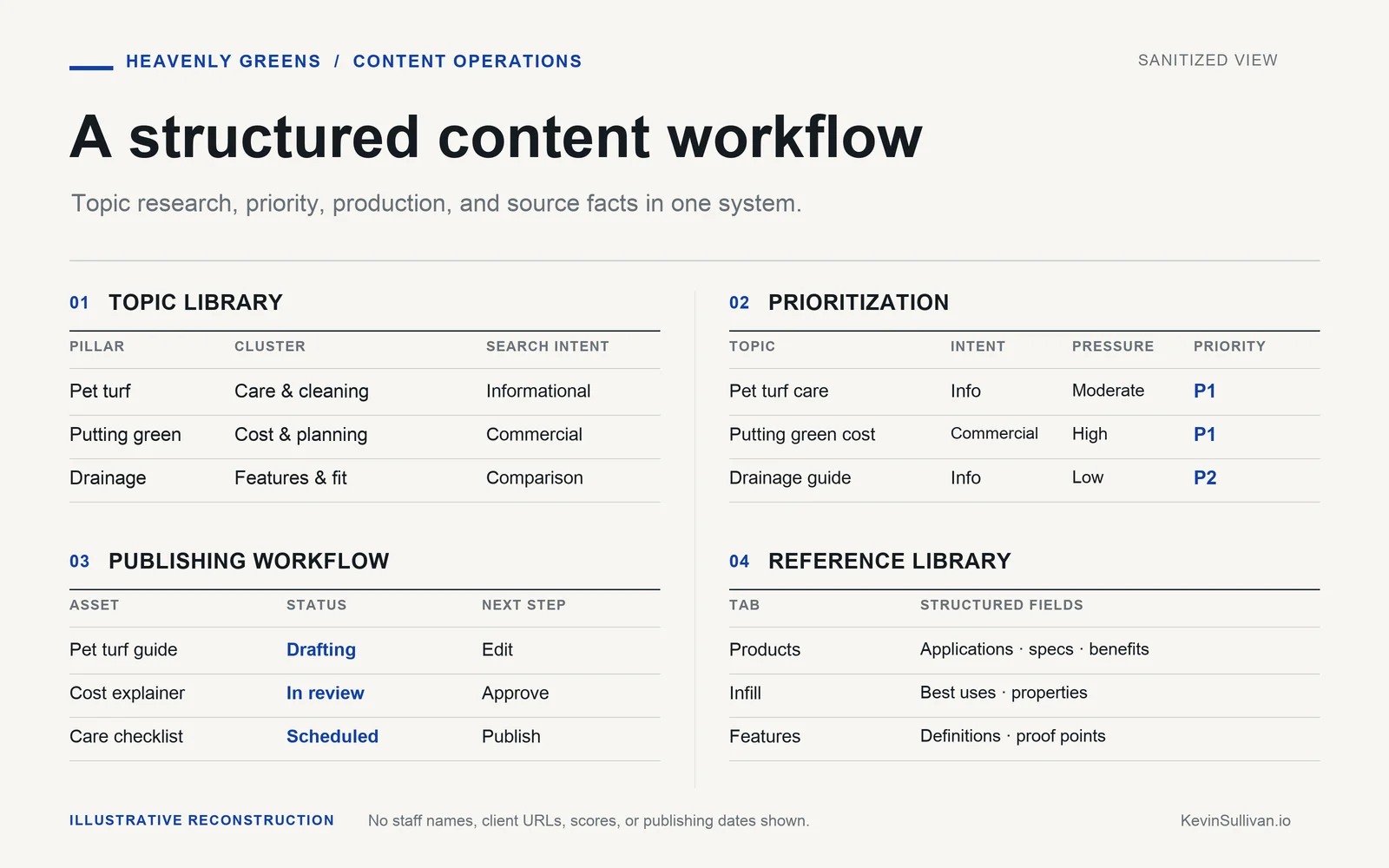
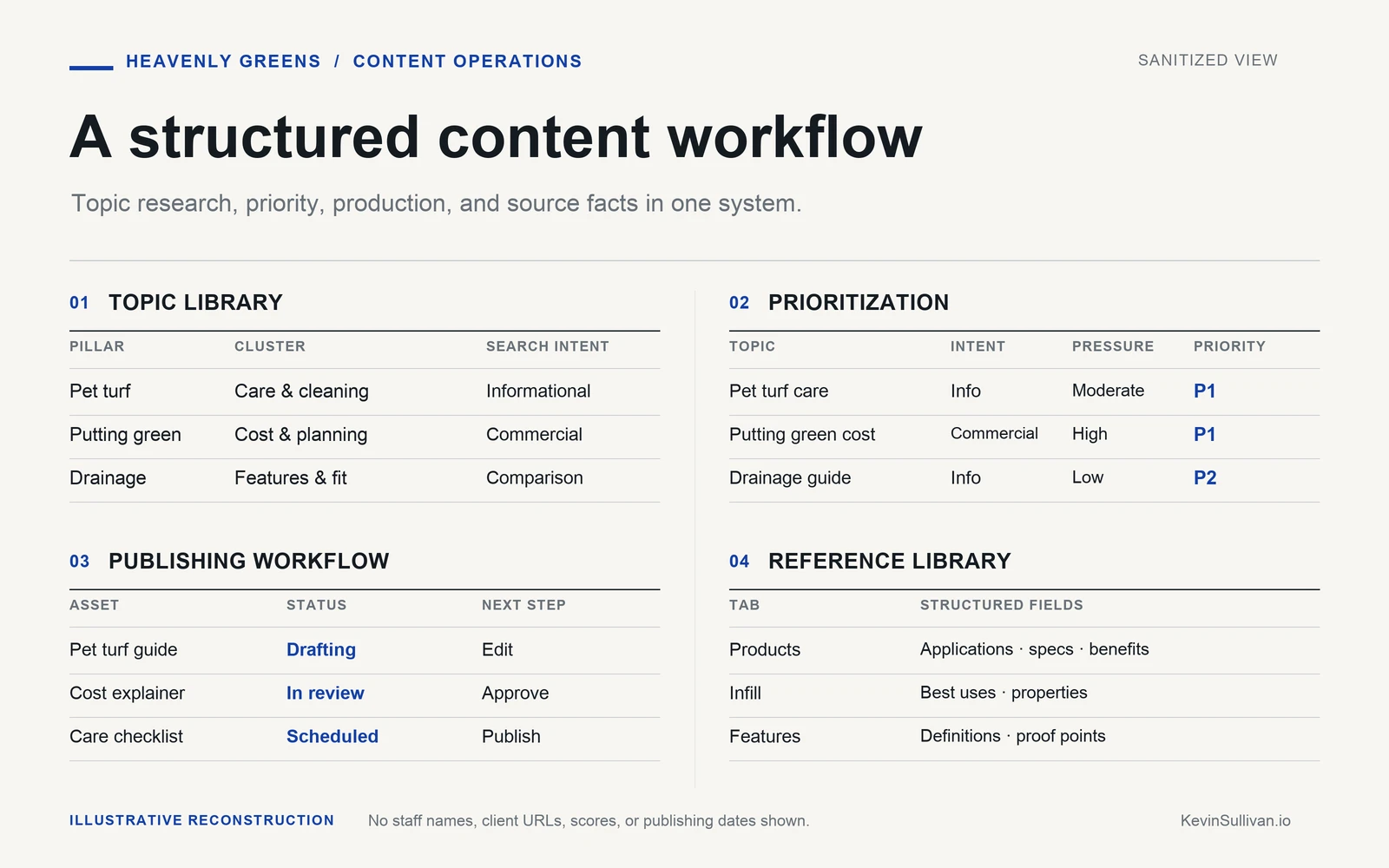
I created a content-management system in Google Sheets and supporting documentation for the content team. The system included:
- A content publishing process
- A topic library
- Search-intent classifications
- Publishing status
- Topic rotation and prioritization
- Product and company reference material
- Internal-link considerations
- Content ownership
- Quality-control steps
- A record of existing coverage to reduce duplication
The product and company reference library helped the team keep content consistent across subjects such as:
- Products
- Accessories
- Installation
- Maintenance
- Features
- System components
- Fiber shapes
- Warranties
This turned content development from a collection of individual assignments into a more controlled operating system.
09Outcome and observation
Results
Posts reduced to focused assets
The most immediate result was a substantially smaller and more intentional content footprint. The final structure made the site easier to navigate, maintain and develop strategically.
It also created clearer relationships among commercial pages, educational resources, products, applications and locations.
Organic traffic and organic leads
Organic traffic increased 1,523% and organic leads increased 471% within approximately three months following the rebuild.
These are reported first-party results. The analytics source, comparison dates and metric definitions are still being confirmed, so they are presented without a chart and should be read alongside the measurement limitations below.
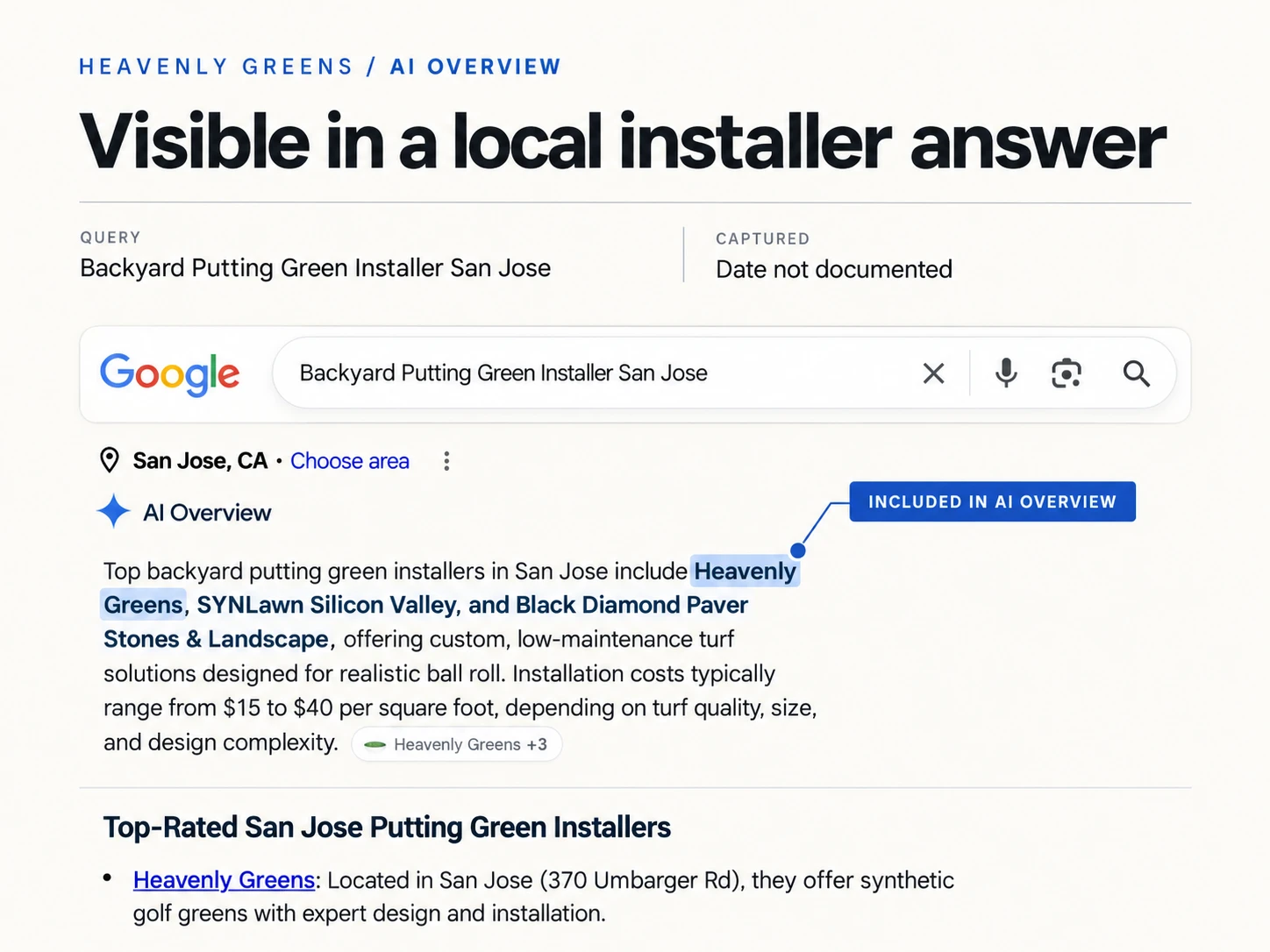
Observed inclusion in Google AI Overviews
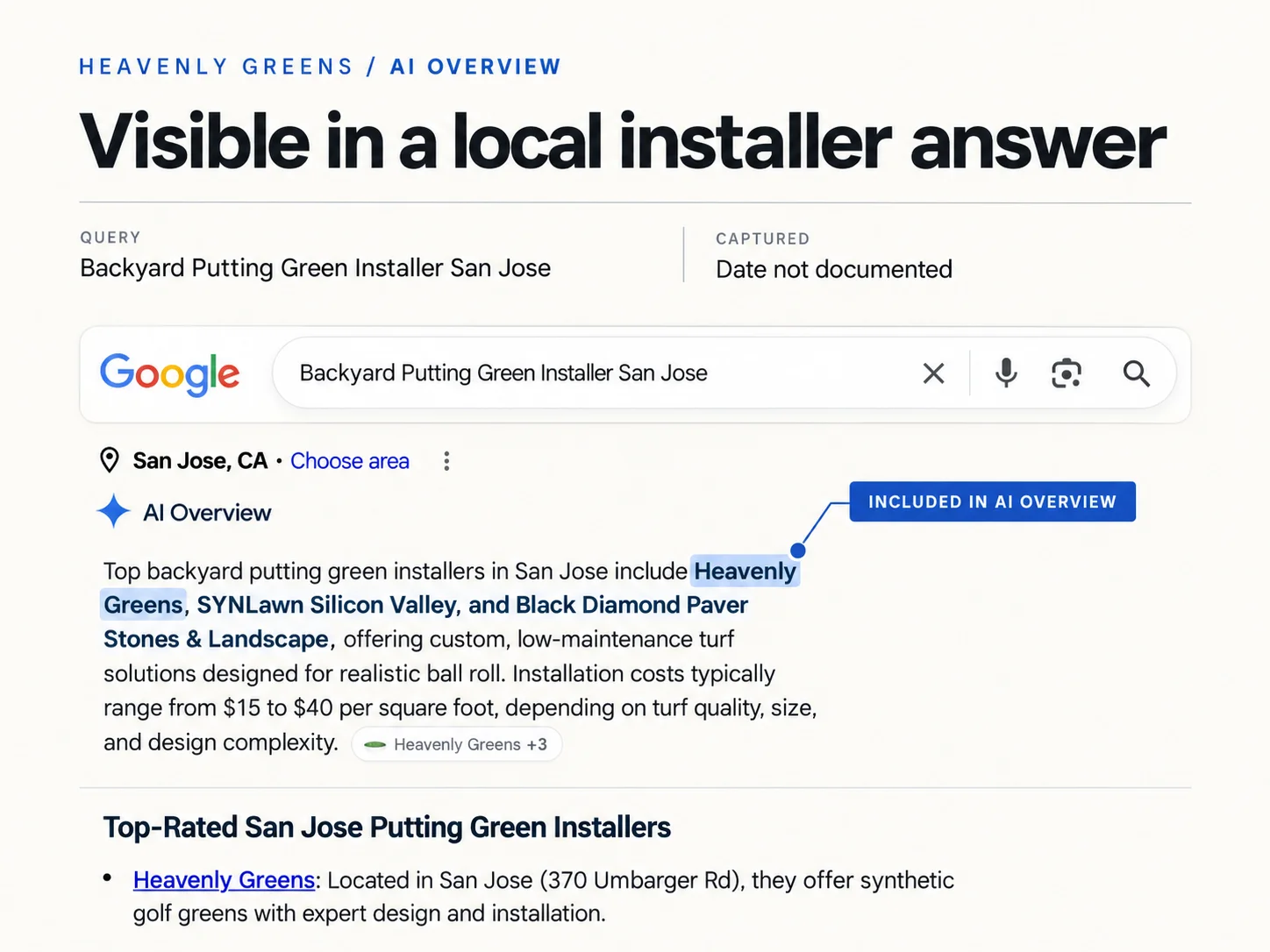
Following the rebuild, Heavenly Greens pages were observed in Google AI Overviews for relevant industry searches.
This is supporting evidence, not proof that the rebuild caused inclusion.
The observation is useful because the new site provided clearer separation among the company, its applications, products, locations and supporting information. Additional controlled testing would be required before making a causal claim.
10Limitations
Measurement limitations
The traffic and lead percentages are reported results. The following details have not yet been confirmed for publication:
- Analytics platform
- Exact baseline dates
- Exact comparison dates
- Whether organic traffic means sessions, users or Search Console clicks
- Definition of an organic lead
- Attribution method
- Whether the comparison started from an unusually low baseline
- Whether the period overlapped with migration, tracking or seasonal changes
Until they are, treat the percentages as directional. The approximately 1,000-to-100 content transformation stands on its own because it describes the documented implementation rather than an analytics outcome.
11
What I learned
More content does not always create more coverage
A large content library can give the appearance of topical depth while making the underlying information harder to interpret. Coverage improves when each page has a clear role.
Consolidation is an information-architecture decision
The project was not about deleting old posts to reduce a page count. It was about deciding which entities, topics and customer questions deserved dedicated pages and how those pages should relate to one another.
SEO and conversion copy should be developed together
A page can match a search query and still fail to help the visitor make a decision. The strongest pages connected search intent, customer concerns, proof and a clear next step.
Publishing systems protect the architecture
A redesigned website can become disorganized again if the content team lacks clear rules. The management system, reference library and publishing process were necessary parts of the SEO strategy.
Content depth is not the same as information clarity
The site did not become more useful by preserving every article. It became more useful by giving the remaining information clearer roles, relationships and paths.
12
What this project demonstrates
This project shows my ability to:
- Audit and consolidate a large content footprint.
- Redesign information architecture around users and entities.
- Balance preservation, consolidation, redirection and removal.
- Connect SEO strategy with conversion messaging.
- Write and implement core website copy.
- Rebuild a website in WordPress.
- Develop lead-generation and sales-support assets.
- Create repeatable content operations.
- Coordinate strategy, implementation and measurement.
- Change the content model when volume no longer serves clarity.