01
At a glance
- Project
- Turf Network
- Industry
- Artificial turf
- Role
- Founder, strategist and builder
- Timeline
- 2023 to present
- Project type
- Owned research and publishing platform
- Platform
- WordPress and WooCommerce
What I own:
- Product and platform strategy
- Information architecture
- Entity modeling
- Website implementation
- Directory development
- SEO strategy
- Content systems
- Structured data
- Internal linking
- Analytics
- AI-search research
- Publishing and iteration
02Context
The problem
The artificial-turf industry contains thousands of organizations, products, applications, materials, technologies and local markets.
Information about those entities is often fragmented across:
- Manufacturer websites
- Installer websites
- Supplier websites
- Product documentation
- Local business profiles
- Trade publications
- Marketing content
- Technical resources
- Distributor and dealer pages
The same concept may be described using inconsistent terminology. Companies can operate as manufacturers, suppliers, distributors, dealers or installers, sometimes combining several roles.
My goal was to explore whether that fragmented information could be organized into a clearer industry resource. The initial challenge was broad:
How do you build a useful information system for an industry when there is no existing audience, content library, data model or established authority?
03Execution
Building the platform from zero
I built Turf Network from concept through implementation. The initial platform combined:
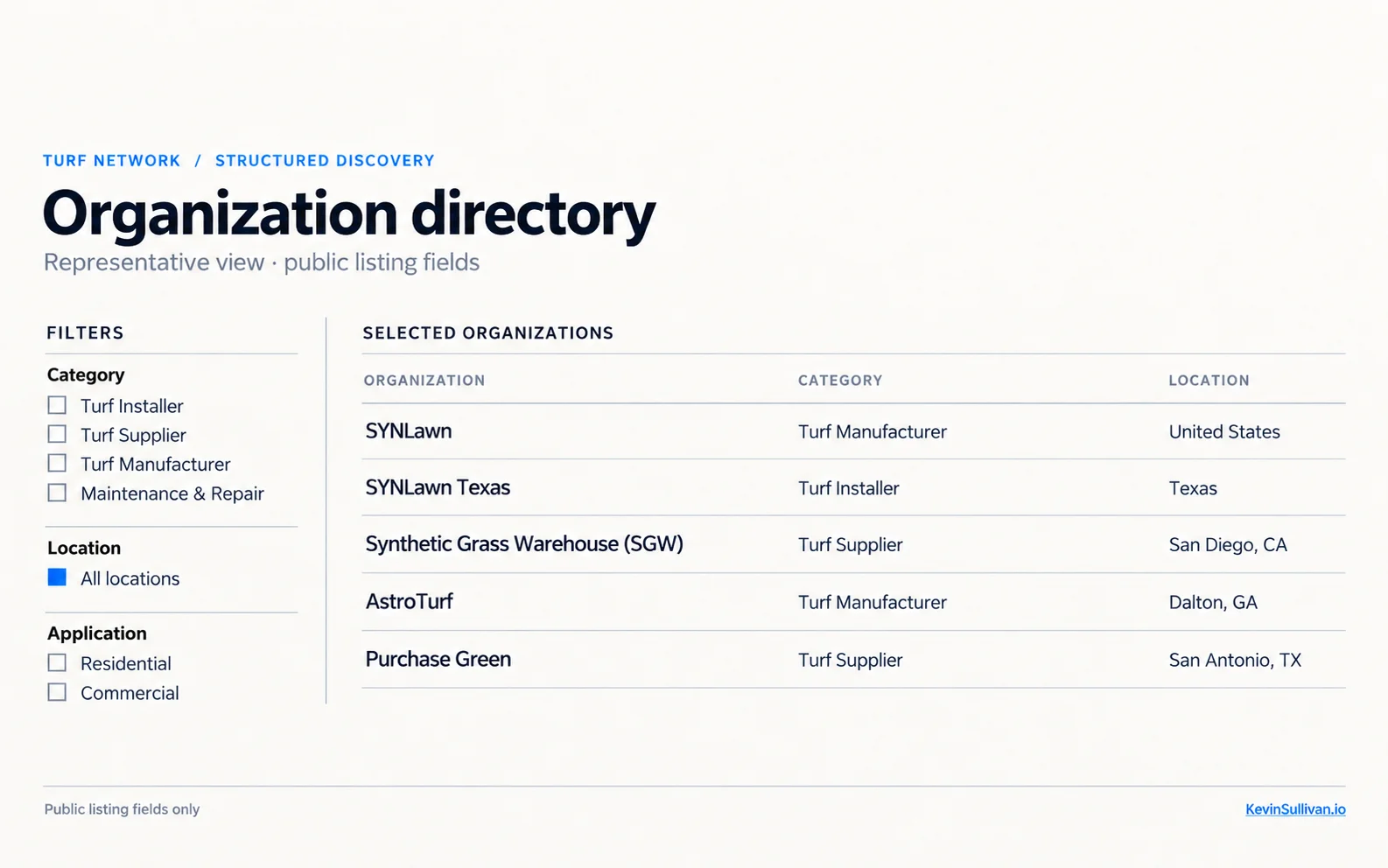
- A national organization directory
- Educational resources
- Product and application information
- Location-based discovery
- Lead-generation assets
- Video and visual content
- Payment functionality
- Analytics and performance monitoring
I assembled a directory containing more than 2,500 industry organizations using publicly available business information.
The directory created industry breadth. It also introduced questions that later became central to the project:
- 01What type of organization is this?
- 02Which locations does it serve?
- 03What products or services does it offer?
- 04Which manufacturers, suppliers or dealers is it connected to?
- 05How should those relationships appear in the site architecture?
- 06What information belongs on an organization page?
- 07What evidence supports each relationship?
04Hypothesis
The original hypothesis
My original strategy relied on a relatively small number of core entity pages supported by large topical content clusters. The assumption was straightforward:
If the platform published the most comprehensive resources in the industry, that depth would help establish topical authority and improve search visibility.
Some supporting articles grew to approximately 6,000 to 10,000 words. The content addressed subjects such as:
- Artificial-turf applications
- Products and materials
- Installation
- Maintenance
- Components
- Performance features
- Technical specifications
- Buyer questions
- Industry terminology
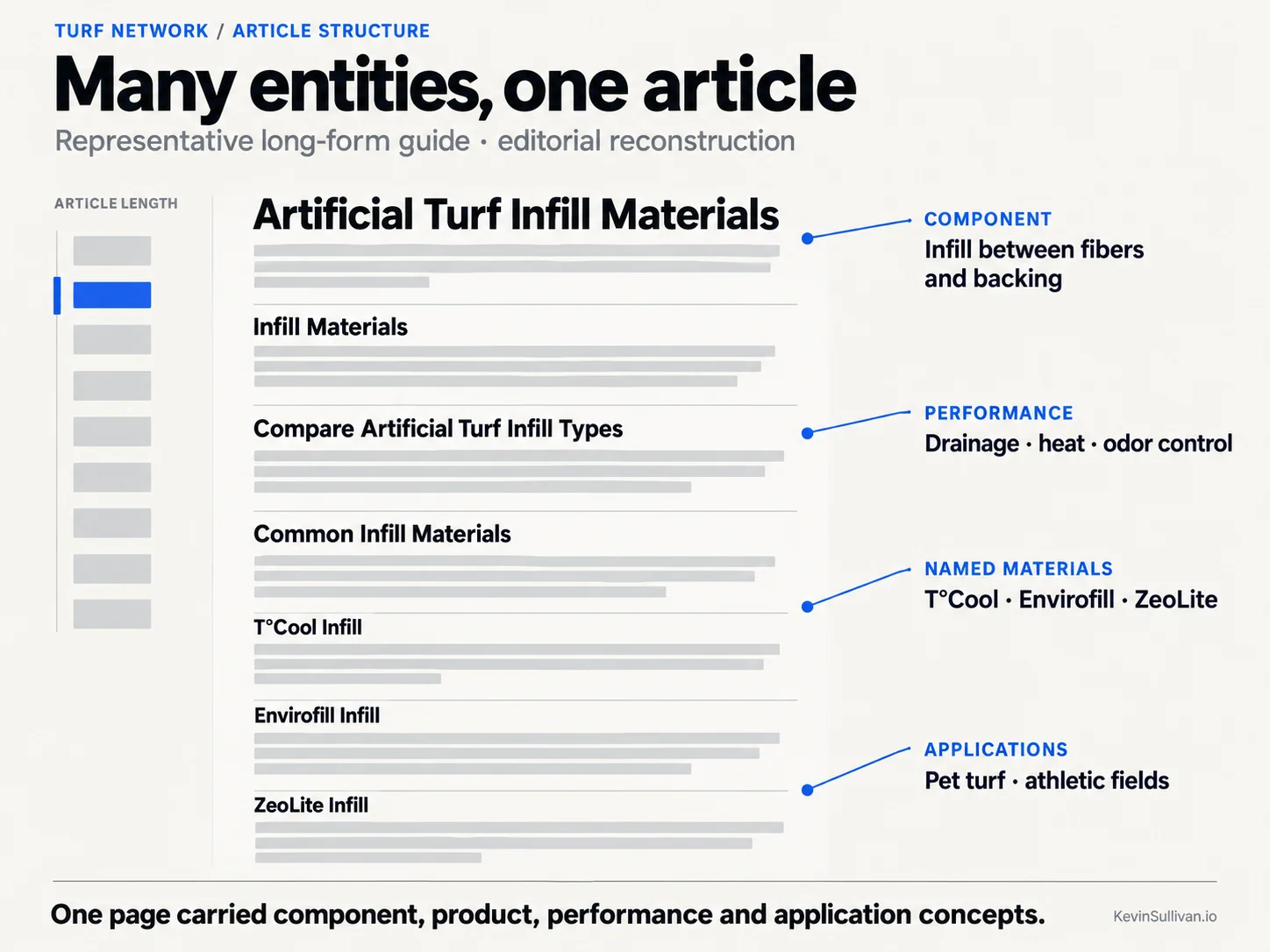
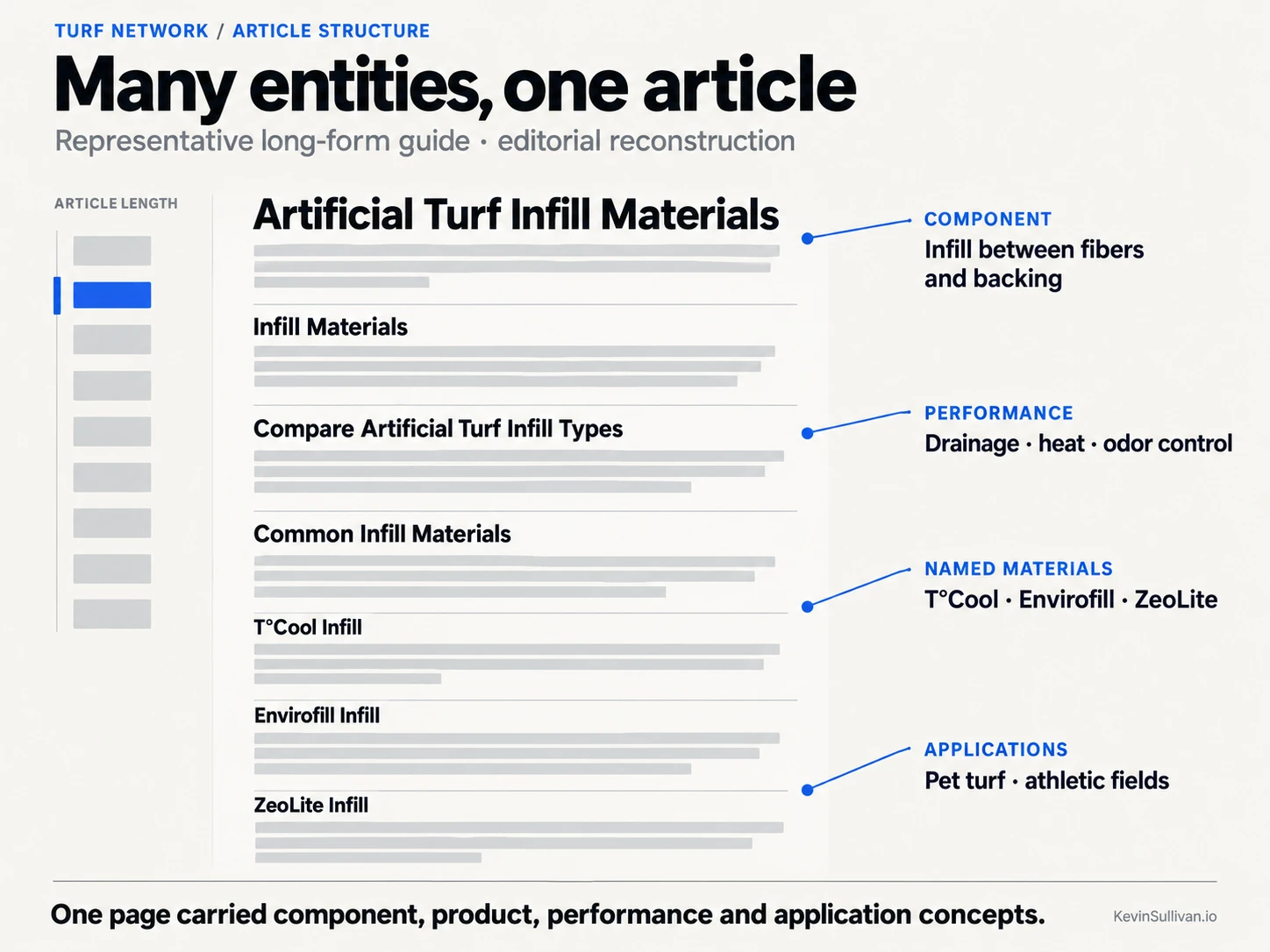
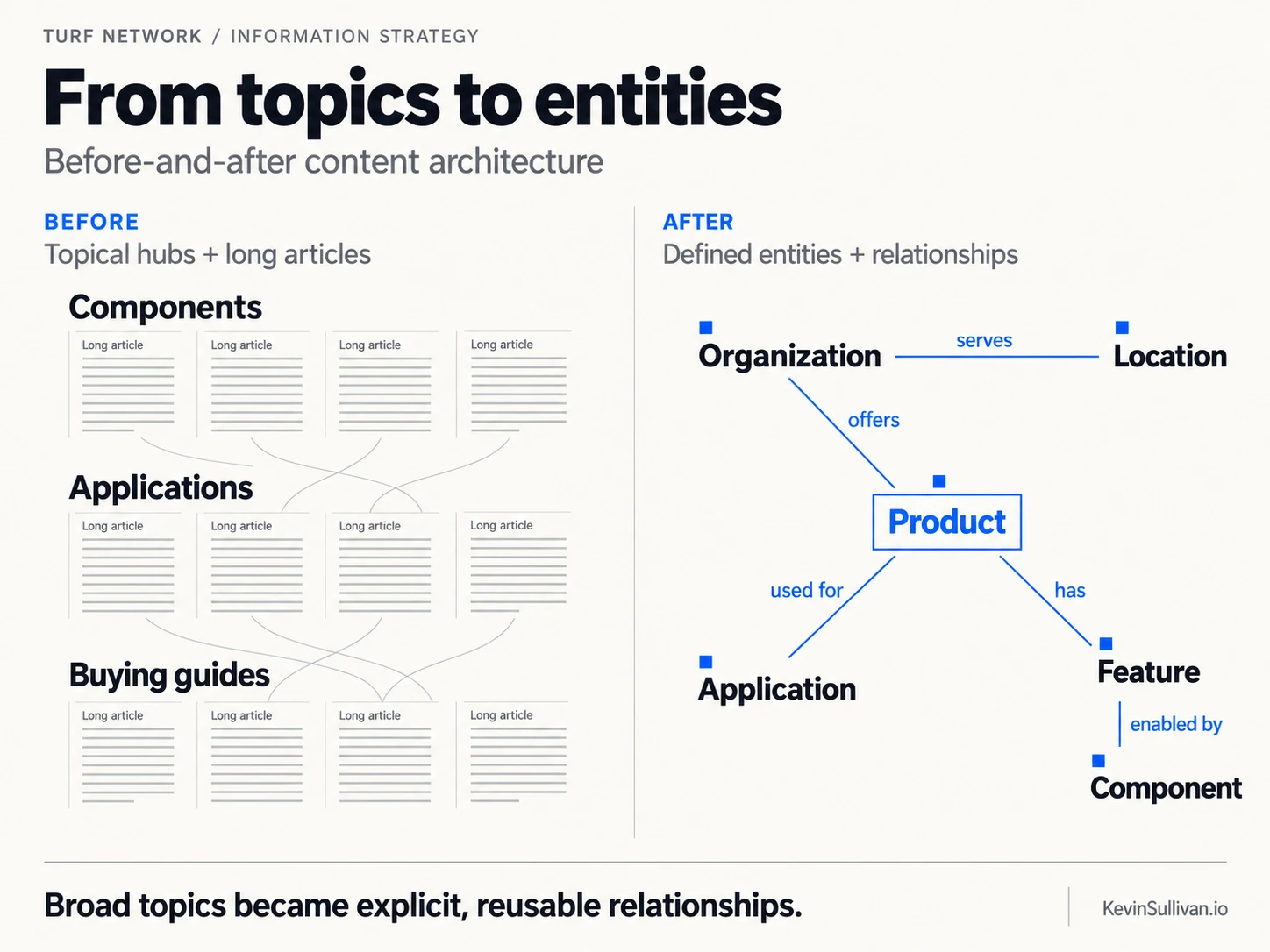
This approach created depth, but it also created a new problem. The articles contained many distinct concepts without always giving those concepts a clear, persistent place in the information architecture.
A single long article might discuss products, applications, components, features, maintenance requirements and installation methods. The information was present, but the relationships among those entities were often buried inside prose.
05Revision
When the evidence challenged the strategy
Publishing more comprehensive content did not automatically create the information structure I wanted. The site had depth, but important concepts were still difficult to isolate, connect, reuse and maintain.
I concluded that several assumptions behind the original strategy needed to change:
- A long page is not necessarily a clear page.
- Mentioning an entity is not the same as defining it.
- Topic coverage does not automatically explain relationships.
- More words can increase ambiguity when several entities share one page.
- Internal links are more useful when both ends of the relationship have clear roles.
- Search visibility alone does not prove that the information model is working.
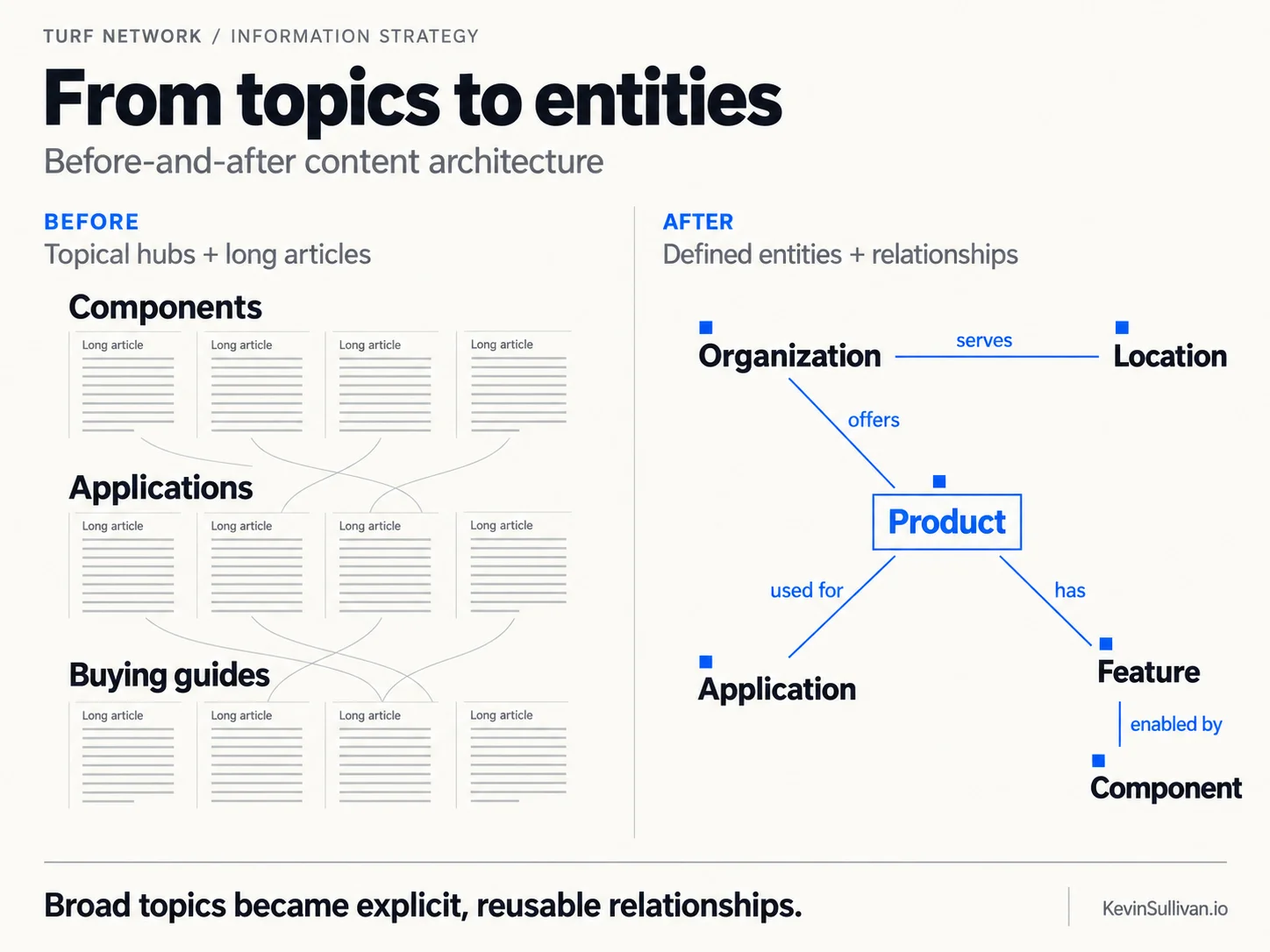
Rather than continue expanding the content clusters, I changed the strategy. I removed oversized content and shifted investment toward:
- Explicit entity pages
- Smaller entity clusters
- Clearer page purposes
- More intentional internal linking
- Structured relationships
- Reusable page frameworks
- More consistent terminology
This produced the principle that now guides much of my work:
Content depth is not the same thing as information clarity.
06Decision
Redesigning the site around entities
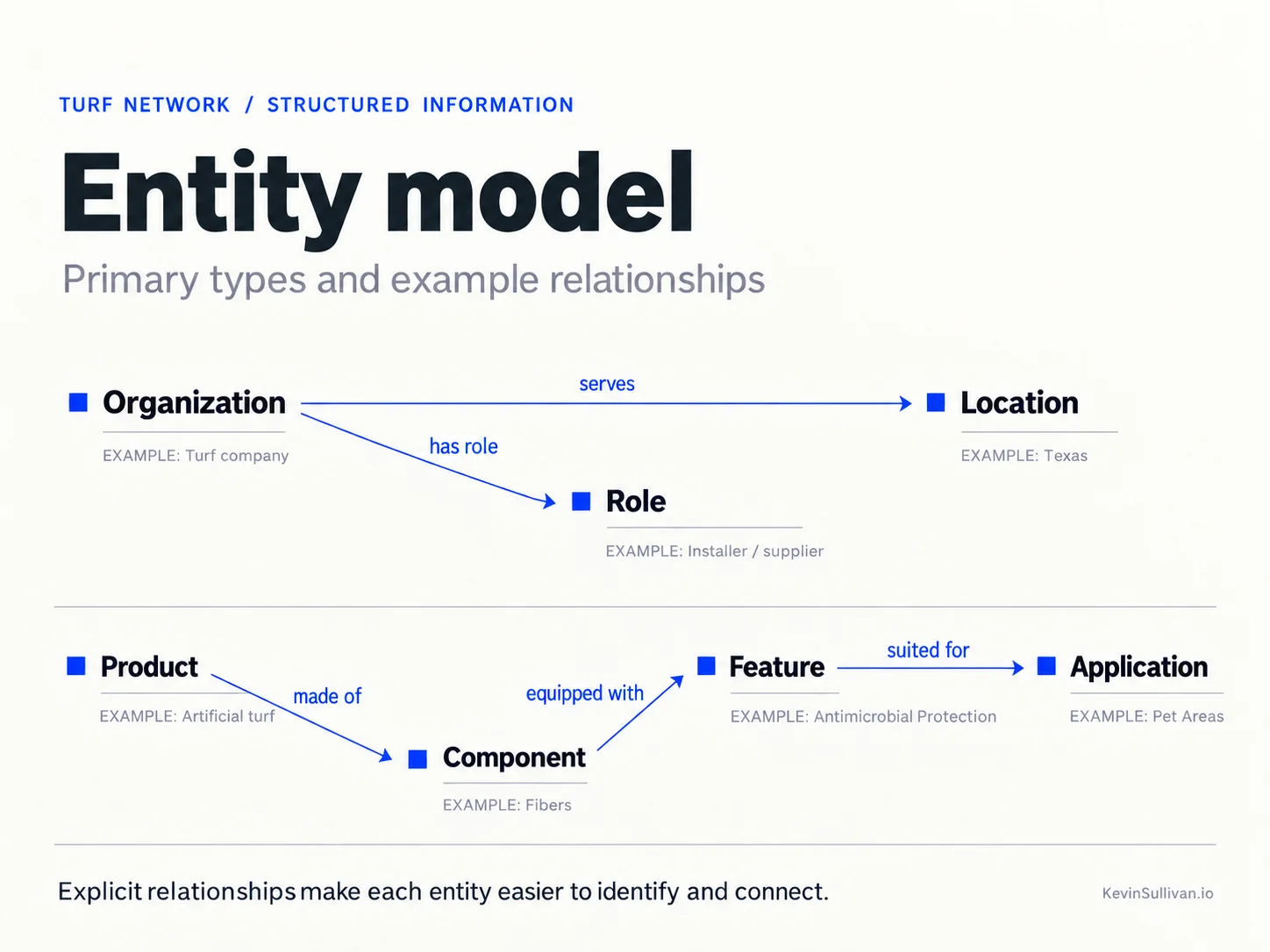
The revised architecture treats important concepts as entities that deserve clear definitions and relationships. The current model includes entity types such as:
Organizations
- Manufacturers
- Suppliers
- Distributors
- Dealers
- Installers
- Industry service providers
Products and systems
- Turf products
- Product lines
- Installation systems
- Accessories
- Supporting materials
Applications
- Residential lawns
- Pet areas
- Putting greens
- Playgrounds
- Sports fields
- Commercial spaces
- Rooftops and specialty installations
Features and components
- Fiber shapes
- Face weight
- Pile height
- Backing systems
- Infill
- Drainage
- Cooling technologies
- Antimicrobial features
Geographic entities
- States
- Metropolitan areas
- Cities
- Service areas
- Organization locations
The site then connects these entities through navigation, contextual links, taxonomies and structured data.
07Execution
Creating reusable page standards
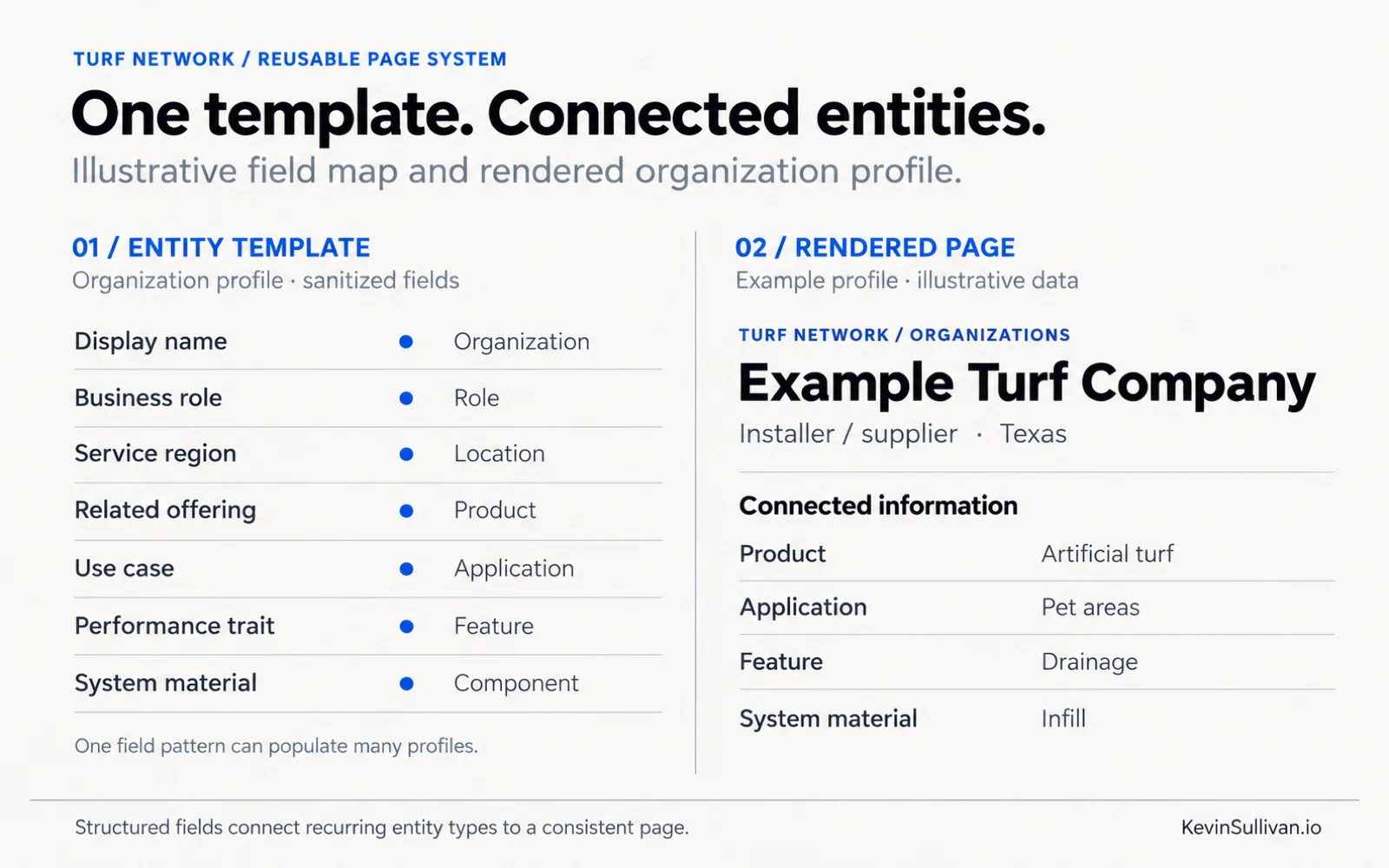
Moving toward entity pages required more than changing URLs. I developed repeatable standards for new page types. Depending on the entity, those standards define:
- The page’s primary intent
- The entity being represented
- Required supporting information
- Related entities
- Internal-link destinations
- Structured-data requirements
- Source and validation expectations
- Publication checks
- Post-launch monitoring
I also created more than 100 custom schema templates using Rank Math to apply structured data across recurring page types.
The templates were intended to improve consistency and make page relationships more explicit. They were not treated as a guarantee of rankings or AI-search inclusion.
08Execution
Using internal links to express relationships
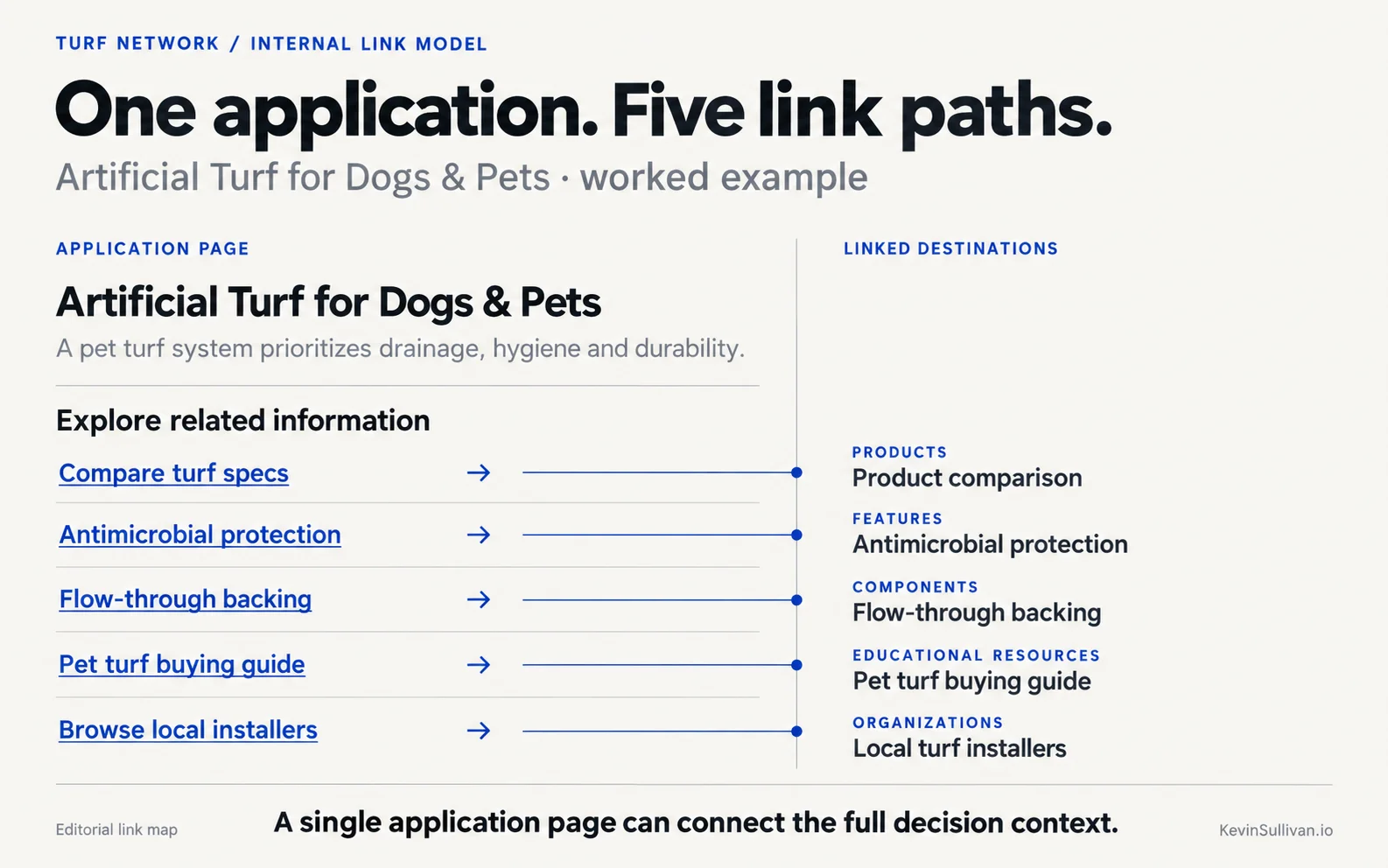
Internal linking became part of the information model rather than a final optimization step. Links were used to connect:
- Products to applications
- Products to features
- Applications to system components
- Organizations to locations
- Educational resources to defined entities
- Industry concepts to supporting terminology
- Local pages to relevant organizations and services
The objective was to create understandable paths for both users and retrieval systems. A visitor reading about pet-turf drainage, for example, should be able to move deliberately among:
- The pet-turf application
- Drainage concepts
- Relevant system components
- Suitable product features
- Installation considerations
- Organizations serving that need
09Research
Turf Network as an AI-search research environment
As generative search became more prominent, Turf Network provided an environment for studying how search systems interpreted structured industry information. I used the project to investigate questions such as:
- Which organizations are included in AI-generated recommendations?
- Which sources are cited?
- How are manufacturers, suppliers, dealers and installers classified?
- Do AI systems distinguish products from applications and features?
- Which pages are retrieved for complex industry questions?
- How does inclusion differ across query types?
- What happens when entity definitions or relationships become clearer?
- Where does external validation appear to matter?
Research included observations across:
- Google AI Overviews
- ChatGPT
- Claude
- Gemini
- Perplexity
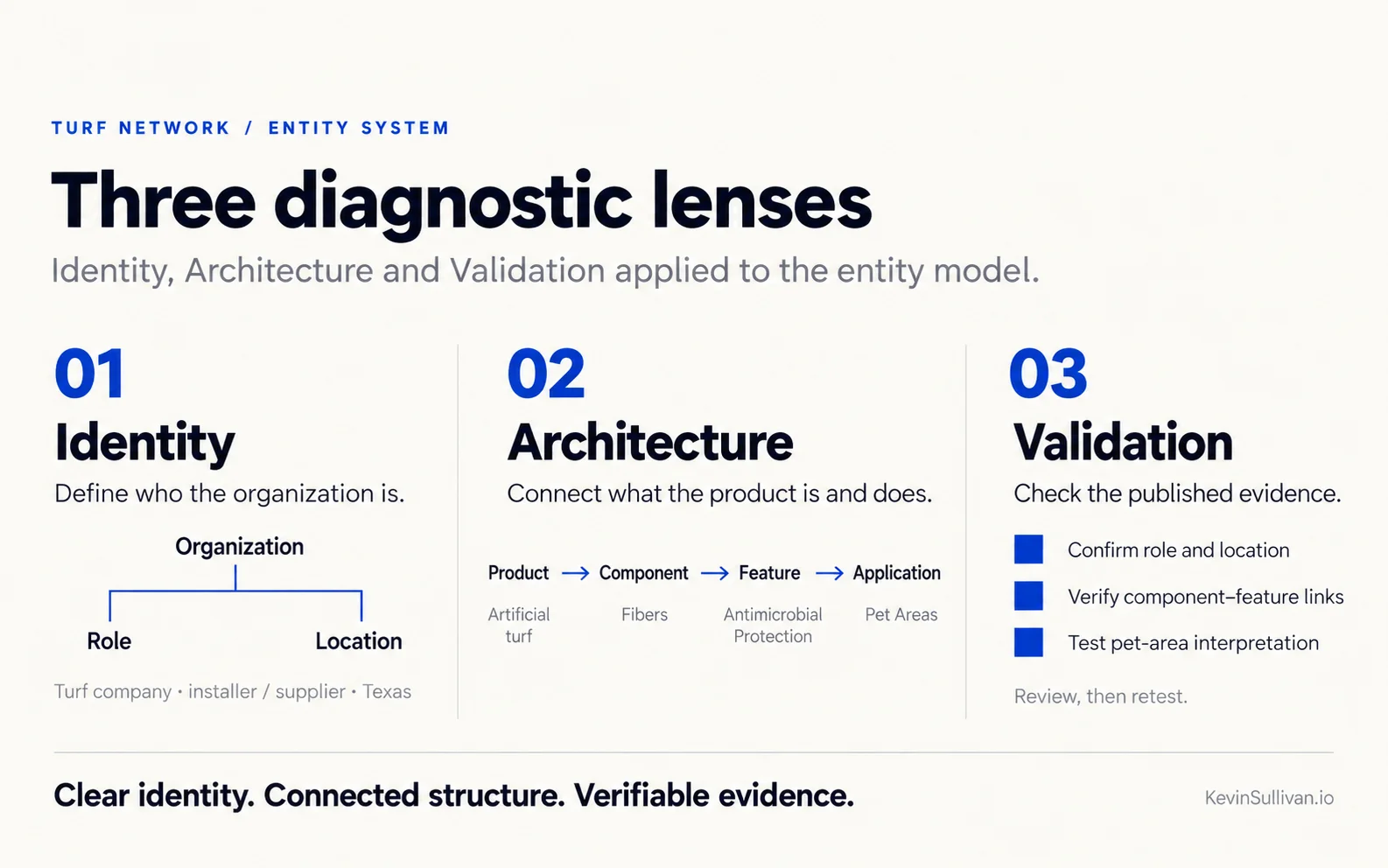
The project contributed to the development of my broader AI Visibility Diagnostic methodology. It helped separate three related questions:
- 01IdentityCan the system understand what the entity is?
- 02ArchitectureCan it understand how that entity relates to other information?
- 03ValidationCan it corroborate the claims being made?
10Observation
Observed search visibility
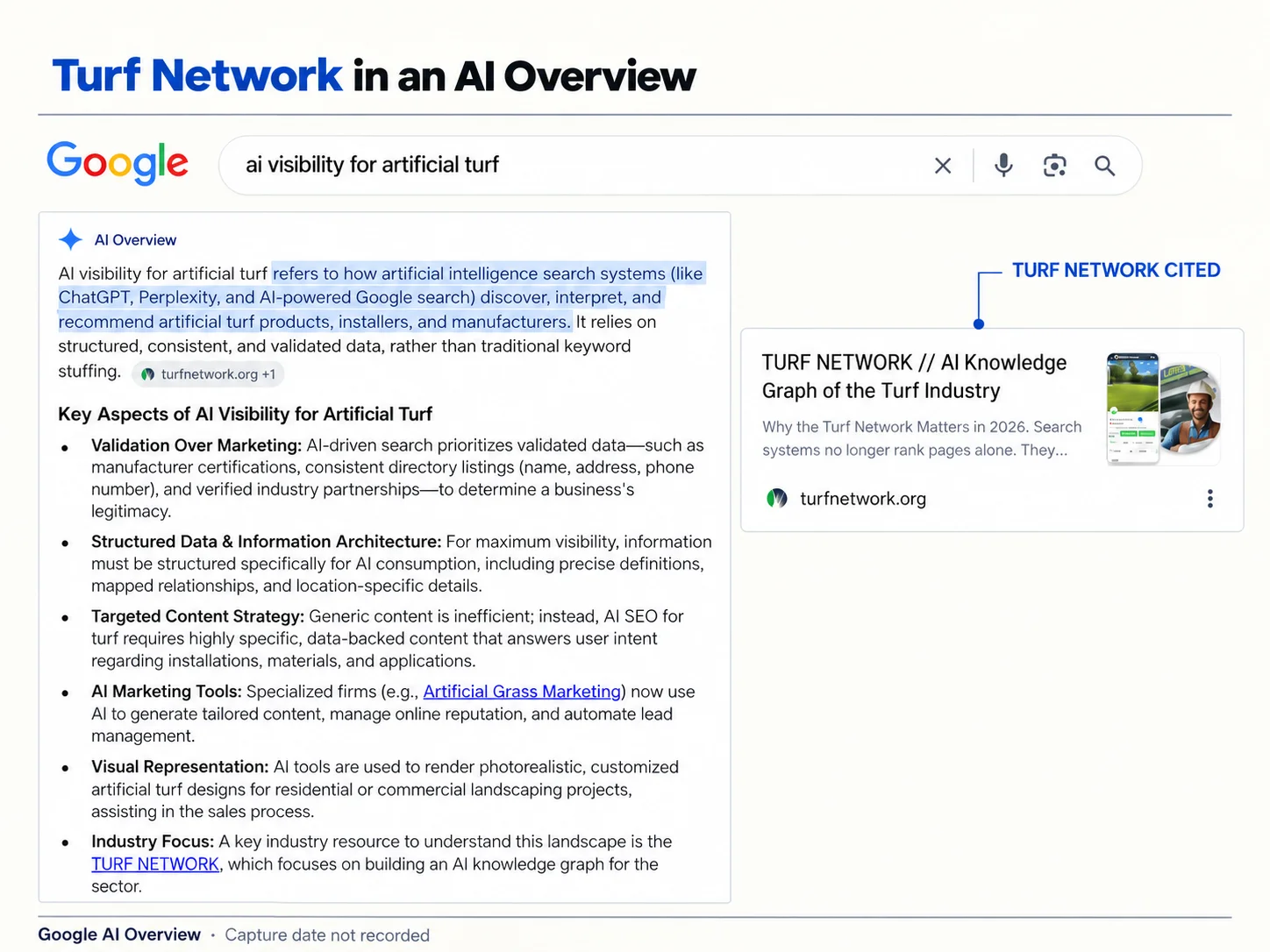
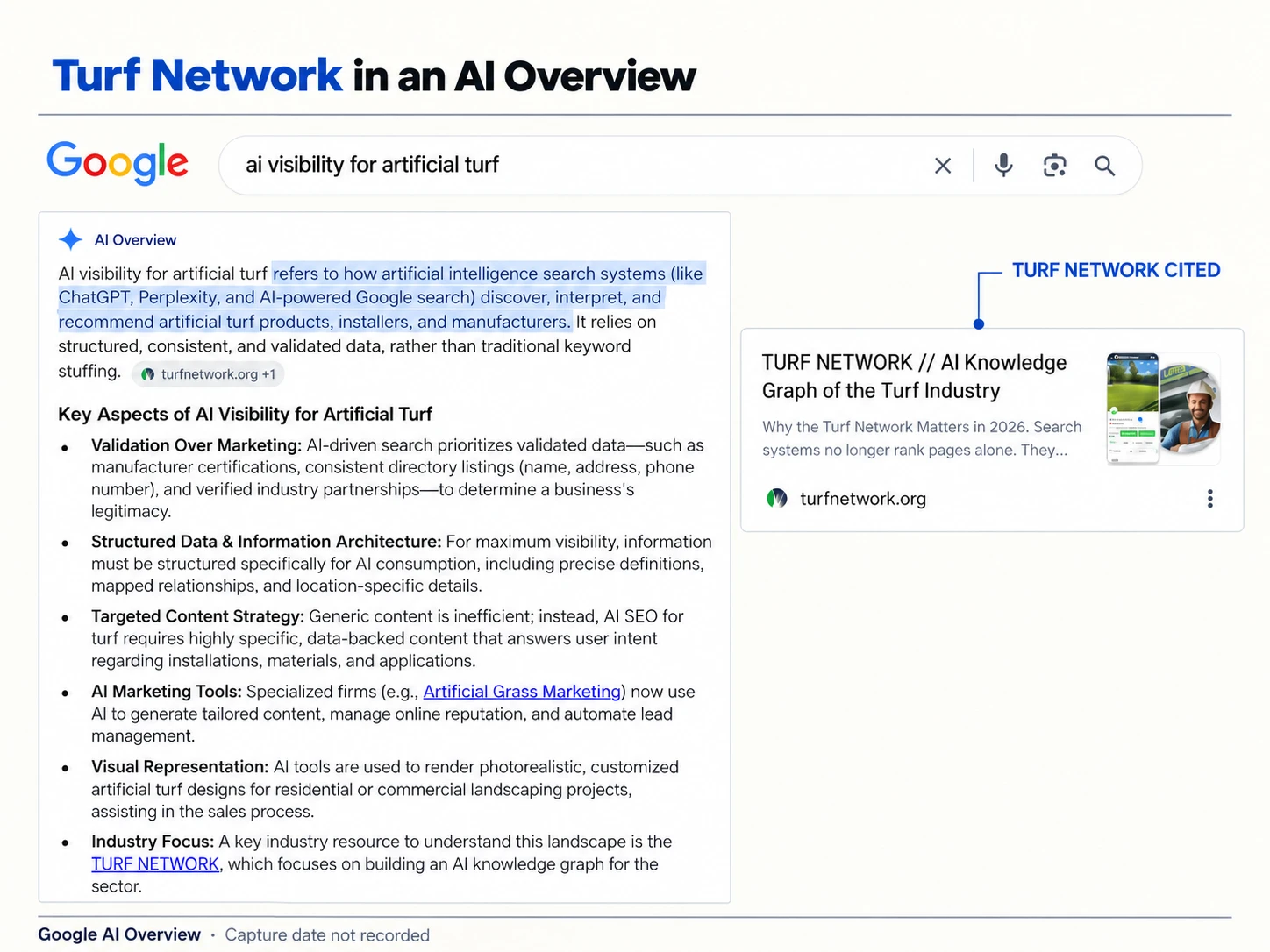
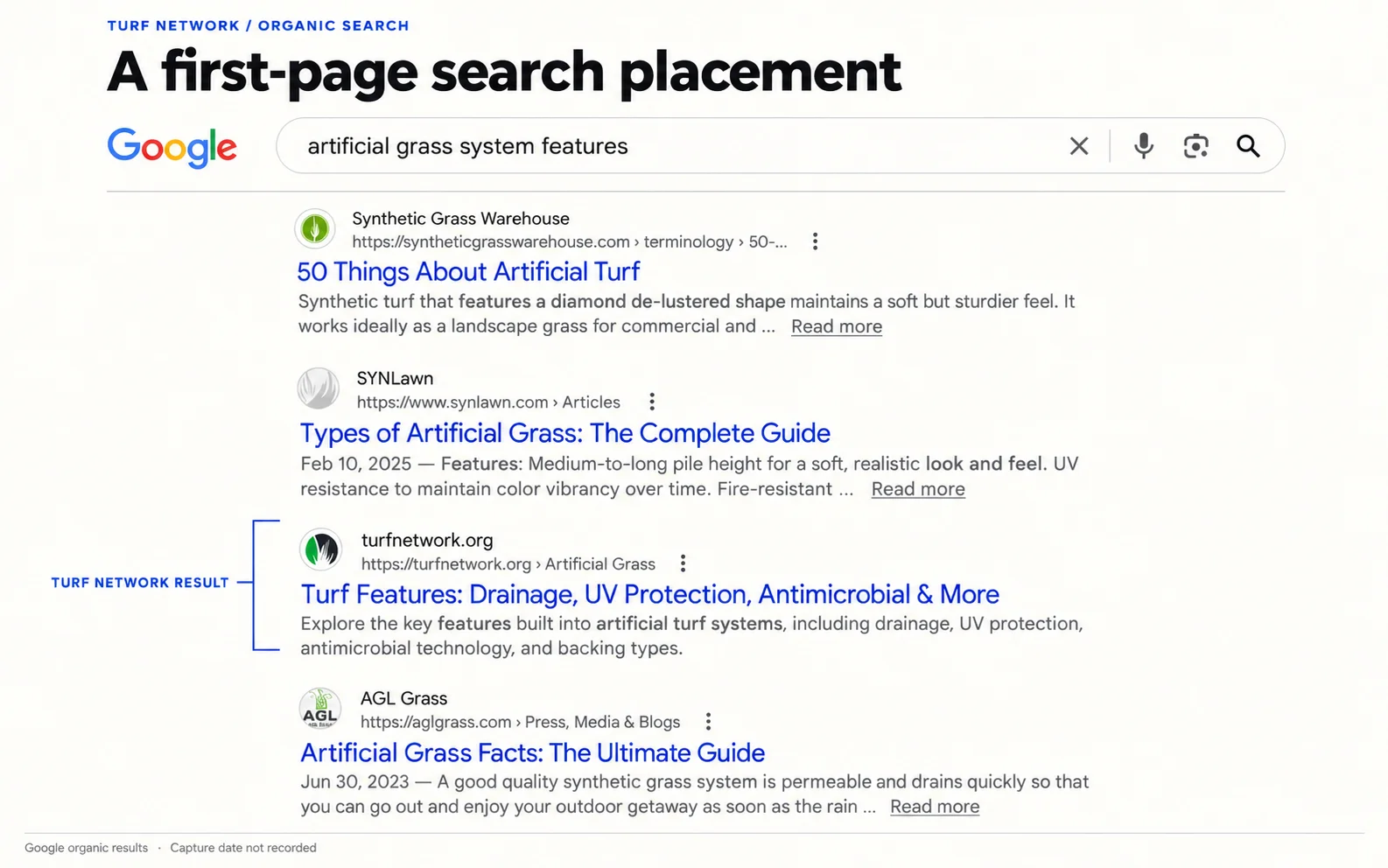
Turf Network pages have appeared in traditional organic results and Google AI Overviews for relevant industry searches. These observations demonstrate that the platform’s information has been discovered and used by search systems.
They do not prove that a specific architecture, schema implementation or content change caused inclusion. AI-search results change over time and can vary based on:
- Query wording
- Location
- Personalization
- Platform updates
- Available sources
- Indexing state
- Competing evidence
For that reason, screenshots are presented as point-in-time observations rather than permanent outcomes or proven ranking relationships.
11Output
What the project produced
An owned industry platform
A functioning platform that combines directory records, educational information, entity pages, structured data, internal relationships and commercial functionality.
A dataset of more than 2,500 organizations
The directory provides a base for investigating organization types, geographic coverage, market relationships and industry structure.
142 entity-focused pages
The revised architecture gives important industry concepts clearer definitions and dedicated places within the site. This count is a point-in-time measure because the platform continues to evolve.
A repeatable publishing system
New page types can follow documented standards for intent, relationships, internal links, structured data, publication and monitoring.
A research environment
Because I control the platform, I can change its structure, document the change and observe what happens afterward. That makes Turf Network different from a client engagement, where experimentation may be constrained by scope, approvals or business risk.
12Limitations
Research limitations
Turf Network is an active project, not a controlled laboratory. Several limitations affect what can be concluded:
- Search systems change continuously.
- AI responses can vary between tests.
- The platform has changed substantially over time.
- Multiple changes may occur within the same period.
- Inclusion does not prove causation.
- Third-party traffic estimates are not first-party analytics.
- A single industry cannot represent all search environments.
- Some entity relationships remain incomplete or provisional.
The purpose of the project is not to claim universal answers. It is to create a disciplined environment for forming hypotheses, testing implementations, recording observations and improving the next version of the system.
13
What I learned
Content depth is not the same thing as information clarity
A comprehensive article can still obscure the individual entities and relationships a user or retrieval system needs.
Being willing to remove work is part of strategy
I had invested significant time in the original content model. When the results and structure did not support the original hypothesis, I removed content and changed direction instead of defending the existing approach.
Entity pages require relationships
Creating one page per concept is not enough. The value comes from defining how organizations, products, features, applications, components and locations connect.
Structure and validation solve different problems
Clear architecture can make information easier to interpret. It does not replace reviews, citations, technical documentation, brand mentions or other forms of external validation.
A system needs operating standards
Scalable publishing depends on rules for page intent, evidence, relationships, internal linking, structured data and quality control. Without those standards, the architecture will gradually become inconsistent.
14
What this project demonstrates
Turf Network shows my ability to:
- Take a search product from concept to implementation.
- Build and manage a large industry dataset.
- Design entity-focused information architecture.
- Create scalable page and publishing systems.
- Connect SEO, content, structured data and internal linking.
- Conduct hands-on AI-search research.
- Distinguish observations from causal claims.
- Document limitations and uncertainty.
- Change strategy when evidence challenges the original hypothesis.
- Turn one-off discoveries into reusable frameworks and standards.
The project is still evolving. That is part of its value. Turf Network is both a working industry resource and a record of how my thinking about content, entities, architecture and AI retrieval has changed through implementation.